
Our tumor-targeting model leverages pro-inflammatory strategies to drive immune cell activation and evaluate anti-tumor efficacy. This platform enables precise assessment of immune-mediated tumor targeting in a controlled and reproducible setting.

Cancer therapeutics and treatment
› Pro-inflammatory efficacy testing
› CAR-T cell and B-cell therapies
› Adaptation to any tumor type

Mechanism of action (MoA) studies
› Analysis of endothelial activation pathways
› Measurement of adhesion molecules and cytokines
› Identification of pro- or anti- inflammatory effects

Vascular modeling
› Vascular flow: capture, rolling, migration and transmigration
› Migratory competence and tumor homing

Bio-imaging
› High-resolution imaging by phase contrast microscopy
› Immunohistochemistry: visualisation of cellular morphology, drug-specific effects
› Adjustable time-course measurements

Cell tracking
› MesenCount and MesenTrack AI-based softwares
› Label-free or immunofluorescence imaging
under flow

Flow Cytometry
› Recovery and phenotyping of recruited leukocyte subsets in whole blood models
› Identification of endothelial cell activation markers
› Measurement of cytokines production
T-cell trafficking- assessment of migratory competence through integrin blockade
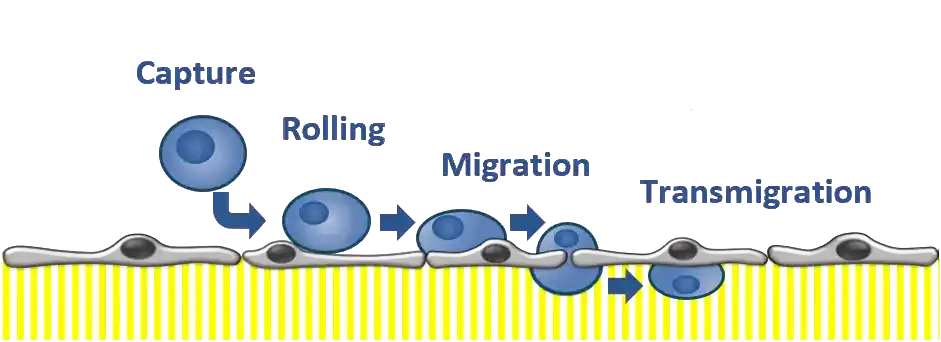
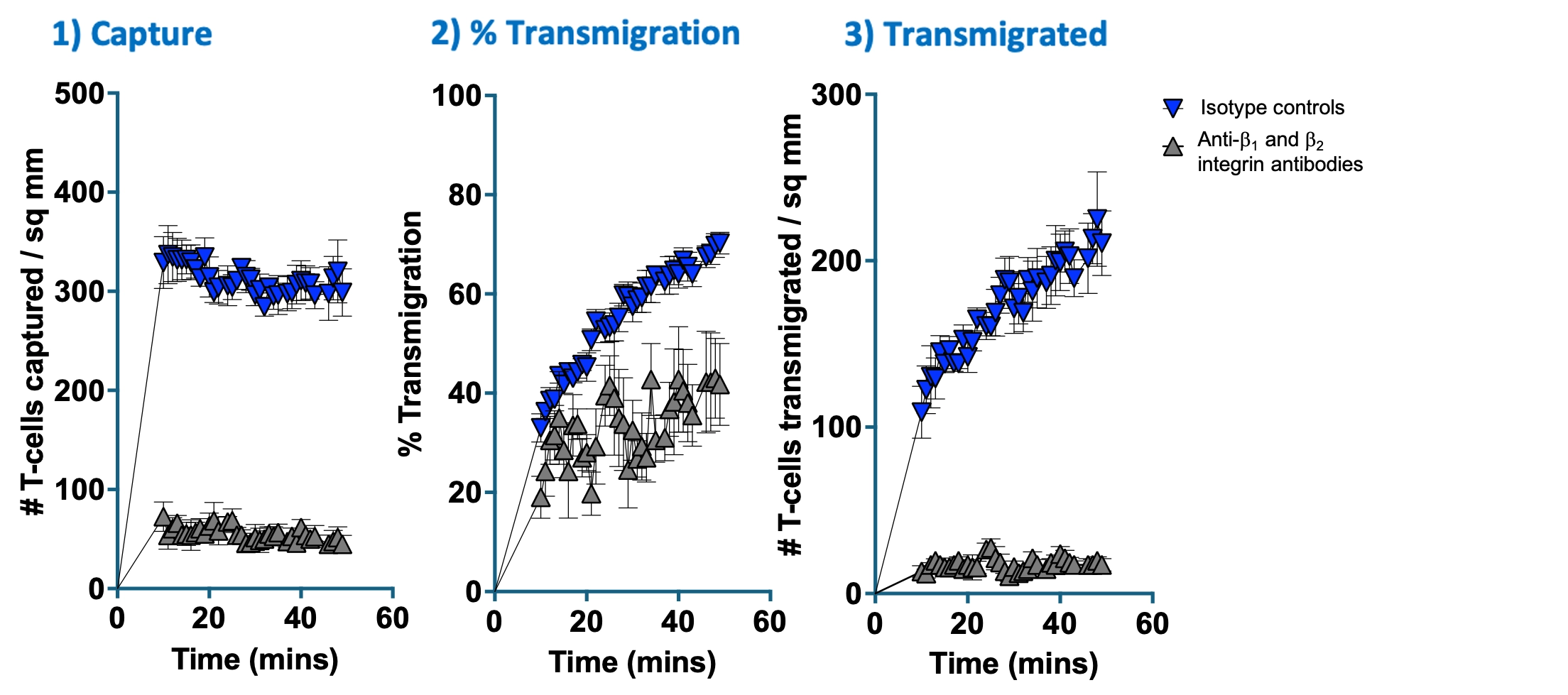
Trafficking profiles of T-cells on human umbilical vein endothelial cells (HUVECs) stimulated with TNFα + IFNγ. The number of T-cells captured (step-1), the percentage transmigration (step-2) and the number of transmigrated T-cell (step-3) were monitored over 50 minutes, with individual cells quantified using our AI-based software MesenCount. Treatment with anti-β1 and anti-β2 integrin antibodies (grey) markedly reduces T-cell capture and transmigration compared to the isotype control (blue).
MesenFlow Technologies SàrlAvenue de la Roseraie 64
1205, Geneva
Switzerland
+41 22 32 16 961 (office)
+41 79 36 66 291 (mobile)